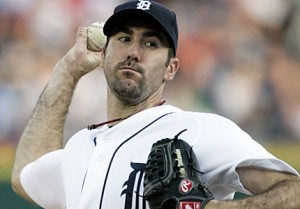
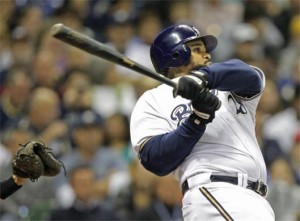
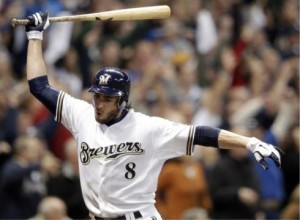
It was a great year for pitchers as a whole, but one hurler was head and shoulders above the rest. In the least surprising news of the off-season, Kevin’s Kings ace Justin Verlander has unanimously won the 2011 DTBL Cy Young Award, to go along with the American League Cy Young Award which he unanimously won earlier this week.
2011 was an amazing, record-setting year for Verlander. He got off to a hot start, highlighted by his second career no-hitter against Toronto in May. He continued to win games start after start and finished the season with 24 victories, tying the DTBL single season record. John Smoltz won 24 games for the Cougars back in 1996 and Randy Johnson equaled that mark for the Kings in 2002. Since that ’02 season, no pitcher had won more than 22 games in a season. In addition to wins, Verlander also led the league in WHIP at 0.920 and 250 strike outs. That WHIP ratio comes in as the sixth lowest single season value in DTBL history. His 2.40 ERA was pretty good too.
Verlander was almost solely responsible for the Kings tying for the second most pitching points in the league. Only one other King won more than 10 games (Max Scherzer), yet the team wound up leading the league in that category. Verlander accounted for almost 20% of the team’s strike outs as well. The Kings picked Verlander in the third round of the 2009 draft after he had spent two seasons with the Demigods. The Demigods let him go after a very disappointing season in 2008. In his three seasons with the Kings, he has won at least 18 games in each campaign. In fact, he has reached that 18 win mark in four of his five DTBL seasons. He’ll need just 13 wins next year to reach 100 for his career. It has been an impressive early career for Verlander, but 2011 was by far his best year yet.
The Cy Young voting results were not surprising, but very interesting none-the-less. Unanimous decisions for awards are fairly common, but rarely do you see complete agreement in both of the top two spots. Verlander received all ten of the first place votes for the maximum 100 points, while the young Mavericks lefty Clayton Kershaw received all ten of the second place votes for 70 total points. Kershaw, the National League Cy Young winner, won 21 games and was right with Verlander in the other categories. Kershaw had the league’s best ERA at 2.28 and finished second to Verlander in wins, WHIP (0.977) and strike outs (248). These two were clearly the best two pitchers in the league in 2011. Although not quite unanimous, Roy Halladay was the clear choice for third place. He earned eight third place votes with the other two going to his Jackalope and Phillies teammate Cliff Lee. Halladay earned 46 points. Lee finished fourth in the vote with 26 points. There was a bit of a gap following the pair of Jackalope. Former Jackalope, current Moonshiner Jered Weaver finished fifth with eight points. Halladay, Lee and Weaver had numbers which would have made them likely Cy Young winners in many seasons, but not this one.
Click here to view the full 2011 DTBL Cy Young voting results.
I’m going to take this time to mention that I never got around to writing that third piece of my season recap, which was supposed to be a statistical look at how much pitchers dominated the 2011 season. Hopefully, I’ll take the time at some point this winter to delve into this, because after glancing at some of the numbers, it is quite apparent that pitching has never been better than it was this year (in the DTBL, that is). All of the players mentioned above played a huge part in this.
The final award, the Most Valuable Player, will be named next Tuesday. There are plenty of strong candidates for that award as well.
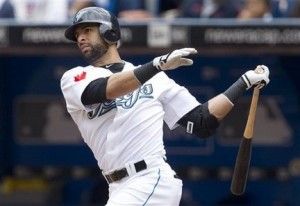
Going into this year’s draft, the 2011 DTBL rookie class was not highly touted. To make matters worse, several of the top youngsters picked in that draft proceeded to have very disappointing and/or injury-plagued seasons. However, the rookie class turned out to be rather deep with a bunch of players taken after the first round easily exceeding expectations. In the end, it was a “veteran” who won the 2011 DTBL Rookie of the Year Award. The honor went to Choppers outfielder Jose Bautista.
2011 was Jose Bautista’s eighth MLB season, but the first season in which he appeared on a DTBL roster, making him eligible for this award. From 2004-2009, Bautista was little more than a platoon/role player in the outfield and at third base with virtually no fantasy value. But in 2010, he broke out in a big way, slugging 54 home runs with 124 RBIs. Those numbers immediately made him one of the most sought after players in this year’s draft. The Choppers felt very fortunate to pick him up with the fourth pick in the draft. Although he entered this season with many wondering if 2010 was a fluke, he did not disappoint. He hit 43 home runs with 103 RBIs and 105 runs scored. His .302 batting average surpassed his previous single season high by more than 40 points. So while ’10 was his true breakout season, ’11 was the year he became a complete hitter and a legitimate superstar. He managed to lead the DTBL in home runs in his very first season. Finishing the season at age 30 made Bautista a very unusual “rookie”, but he is not the oldest DTBL ROY winner. I believe that distinction belongs to Andres Galarraga who won the league’s first Rookie of the Year Award in 1994 at the age of 33.
Bautista was a huge part of a vastly improved Choppers squad. Although they finished the season in sixth place, the Choppers were in the hunt until the final month of the season and were much more competitive than they have been in recent years. That is largely due to the significant power boost provided by Bautista and Curtis Granderson. The slugging duo finished first and second in the league in home runs. Both figure to be strong candidates for the MVP Award, which will be announced next week. The Choppers finished in the top half of the league in all five offensive categories, a year after finishing in the bottom half in all except batting average.
The depth of this year’s rookie class is very apparent after taking a glance at the award’s voting results. American League Rookie of the Year Jeremy Hellickson was on the DTBL ballot as well, but did not receive a single vote. Bautista won the award by garnering 7 of the 10 first place votes and a total of 87 points. The runner up was Bautista’s Choppers teammate, relief pitcher Craig Kimbrel. Kimbrel saved 46 games with a 2.10 ERA, 1.039 WHIP and an extremely impressive 127 strike outs. He was named the National League Rookie of the Year earlier this week. Kimbrel was a third round pick by the Choppers. Since they traded away their second round pick, all the Choppers first two picks wound up doing was finish first and second in the DTBL ROY vote. Kimbrel received the other three first place votes and accumulated 75 points. Another closer came in third, the Jackalope’s John Axford, who matched Kimbrel’s 46 save total. The only pitcher with more saves than these two DTBL rookies was Jose Valverde. Axford received enough votes to get 37 points. His Jackalope teammate, slugging outfielder Mike Stanton, finished fourth. Stanton’s 34 home runs gave the champions just the kind of power threat they needed. Just like the Choppers, the Jackalope struck gold in the first couple rounds of the draft. Stanton was a first round selection and Axford was picked in the second round. Rounding out the top five was yet another closer, the Moonshiners’ Drew Storen. Storen saved 43 games. The Kimbrel/Axford/Storen combination is about as good of a set of rookie closers as you will ever see.
You’ve heard all about the champion Jackalope. Now it’s time to take a look back at the 2011 season for the other nine teams. I’ve grouped them into three categories: the good, the bad and the ugly. These groups don’t necessarily relate to the order of finish, but how competitive the teams were compared to expectations. The three teams I identified as “good” all finished higher in the standings than they did a year ago and should feel like they are headed in the right direction. “Bad” isn’t really the right word for the second group, because two of the three teams actually finished near the top of the standings. Disappointing is a better way to describe them. Finally, the teams that fall into the “ugly” category would probably like to pretend 2011 never happened.
THE GOOD
Mike’s Moonshiners
The quickest team out of the gate, the Moonshiners led the league for a good part of the first quarter of the season. They stumbled a bit in early summer and never really recovered, finishing in third place. However, that was up two spots from a year ago and was their best finish since 2008. The improvement was almost entirely due to the pitching staff, which received a huge boost from the Jackalope trade which brought them ace pitcher and Cy Young candidate Jared Weaver. While I already mentioned how beneficial that trade was to the Jackalope, the impact was similar for the Moonshiners. Weaver turned their average pitching staff into one of the league’s best. He finished in the top five of the league in ERA, WHIP and wins. Meanwhile, the offense was carried by slugging first baseman Prince Fielder (38 HR, 120 RBI) and 30/30 man Ian Kinsler (32 HR, 30 SB). Now that the pitching staff has been fixed, the Moonshiners will look to improve their offense going into 2012. With the Jackalope winning their first title this year, the Moonshiners are now the longest tenured DTBL team without a title. They figure to have a good chance to change that next year.
Dom’s Demigods
The biggest jump in the standings was made by the Demigods. After finishing dead last a year ago, they managed to move into the top half of the standings with a fifth place finish in 2011. This is despite the fact that they got almost nothing out of their first overall pick (Buster Posey); same with his catching partner Joe Mauer. The rest of the offense was surprisingly good though, finishing in the top five in every category and leading the league in batting average. The indisputable MVP of the team was Matt Kemp, who hit .324 with 39 HR, 126 RBI, 115 R, 40 SB. He led the league in RBIs and was the only player to appear on the league leaderboard in all five categories. He even flirted with the NL Triple Crown until the final week of the season. The pitching staff was a bit of a disappointment, but overall, the Demigods appear to be headed in the right direction.
Charlie’s Thunder Choppers
Although they only wound up finishing one spot higher than a year ago (6th, up from 7th), this was a much better year for the Choppers. They were a title contender in the second half of the season for the first time in five years. They wound up finishing 16 1/2 points out of first, cutting almost half the deficit from a year ago (32 points). As I documented in an article a couple months ago, it was some recent first round draft picks that helped pump some more juice into the Choppers offense. Jose Bautista and Curtis Granderson finished first and second in the league in home runs (43 and 41 respectively). Both are strong MVP candidates, while Bautista is even eligible for the DTBL Rookie of the Year award. Granderson led the league with 136 runs scored, the highest total since 2007. The Choppers boast another strong ROY candidate in closer Craig Kimbrel who saved 46 games in his first full MLB season. If the Choppers can add one or two more elite starting pitchers, they are another team to watch in 2012.
THE BAD
Nick’s Naturals
Okay, I admit it isn’t really fair to put the Naturals in a category labeled as “bad”, because they were definitely not that. But a defending champion almost always has its sights set on repeating, and the Naturals weren’t quite able to do that this year, finishing a distant second. In some ways, this Naturals team was every bit as good as the one that tied for title last year, but the Jackalope were just a little better. The Naturals were unable to repeat their amazing feat of 50 batting points from a year ago, but still led the league with 45. They figured they would need to get more out of their pitching staff though. Unfortunately for them, that didn’t really happen. Newly acquired Zack Greinke was solid, but he, along with the rest of the staff, didn’t have a truly spectacular season. Still, the Naturals shouldn’t regret their Greinke/Howard trade, because the pitching would have been worse without Greinke. Miguel Cabrera and Joey Votto led the league’s best offense. Cabrera won the batting title with a .344 average. Overall, there is nothing for the Naturals to be ashamed of this year. They were as close as one half point behind the Jackalope in late August. They figure to be right back in the title hunt again next year.
Kevin’s Kings
Again, this wasn’t a “bad” season for the Kings. They finished exactly where they did a year ago, in fourth place. However, this time fourth place meant 15 points back and not really a serious contender down the stretch. Last year, they were in the hunt right until the end and finished just five points behind the co-champions. Other than place of finish, there was virtually nothing in common between the 2010 and 2011 Kings. This year’s squad had a below average offense and one of the league’s best pitching staffs. It was just the opposite in ’10. The main reason for the pitching upswing was one man: Justin Verlander. Verlander tied a DTBL single season record with 24 wins. He also led the league in WHIP (0.920) and strike outs (250). Really, he’s the only Kings pitcher who sticks out as having an impressive year, yet they managed to garner 40 pitching points. On offense, it was an underwhelming and injury plagued season for almost all of the Kings stars. Jose Reyes bounced back to being one of the league’s elite players, but he too couldn’t stay healthy. It is hard to say where this franchise is headed. Without Verlander’s monster year, they could have finished near the bottom of the standings this year. On the other hand, had a few key guys stayed healthy, they may have been in the hunt until the end.
Marc’s Mavericks
Now this is the one team in this group where the “bad” label probably applies. For the second straight year, the Mavericks finished in eighth place. But this isn’t a franchise that typically goes through long rebuilding processes. Last year, they were completely wrecked by injuries and essentially gave up with a couple months to play. This year, they had some injuries, but that wasn’t the biggest problem. Disappointing seasons from almost all of their young players gave them little hope of competing. They have had five first round picks the past two years, and I would call several of them major disappointments at this point. Carlos Santana and Matt Wieters had decent seasons at a weak offensive position, but the jury is still out on them. Gordon Beckham and Jayson Heward have been huge busts so far. The only Maverick who really stood out as having a tremendous 2011 season was Clayton Kershaw. Kerhsaw led the league in ERA (2.28) and was just behind Verlander in WHIP (0.977), wins (21) and strike outs (248). It should definitely come down to those two for the Cy Young award. The Mavericks really need to hit some home runs with their early picks in next year’s draft because the last two years have been rather forgettable.
THE UGLY
David’s Darkhorses
The Darkhorses set a standard of excellence in winning four consecutive DTBL championships from 2006-2010. This year, not only did they fail to meet that standard, but they wound up with the worst finish in league history for a defending champion, finishing a distant seventh. They won those four titles by having the most balanced team in the league, usually finishing first or second in both batting and pitching. This year, they somehow managed to fall to the middle of the pack in both areas. Injuries were a factor, but not to the extent you would expect for a team that fell apart like this. Below average seasons for most of the roster is the main explanation. I suppose it was bound to happen eventually. On the bright side, Jacoby Ellsbury turned himself into one of the best fantasy players with a 32 HR, 39 SB season while hitting .321. His Red Sox teammate Adrian Gonzalez had another solid year for the Darkhorses, but dropped off a bit in the second half. One major problem with the pitching staff was the criminally bad run support Tim Lincecum received. He only won 13 games despite putting up his usual dominating numbers in the other categories. James Shields and Chris Carpenter also won fewer games than you would expect from their other numbers. I’ll chalk this up as a worst-case scenario season for the Darkhorses. Surely, things will go better next year.
Greg’s Gators
I should point out that until the final day of the season, it appeared the Gators, and possibly the Cougars as well, were going to break the DTBL record for fewest total points in the 10 team era. Fortunately for them, both teams picked up a point or two in the final day and avoided this place in history. They wound up tied for ninth place with a putrid 21 total points, one clear of the record low mark of 20 by Tim’s Titans in 1999.
While the Gators did avoid that distinction, they managed to set a different low water mark. Their six batting points are the fewest ever in the 10 team era (since ’98, batting or pitching). Only a couple stolen bases prevented them from finishing dead last in all five offensive categories. Sadly, they were in last by a fairly wide margin in most categories. They are going to have a tough time finding enough players worthy of keeping. About the only offensive player who put up keeper-worthy numbers was Dan Uggla, and even he only hit .233. The pitching staff was a little better, mostly thanks to C.C. Sabathia. Injuries to Jair Jurrjens and Josh Johnson prevented them from having a pretty respectable staff. Overall, there is a lot of work to do for this squad. I think 2011 was clearly the worst season in franchise history.
Kelly’s Cougars
I think Kelly clearly had more important things on her mind this year, which caused her to not put a lot of time and effort into her team. I’m not sure it would have mattered though. Much as was the case with the White Sox, Adam Dunn almost single-handedly ruined the Cougars season. Nobody had a particularly good season either though. Josh Hamilton fought through injuries, and other key players were simply inconsistent. The pitching staff was especially poor, though that can be partly blamed on the loss of staff ace Adam Wainwright to Tommy John surgery before the season even started. This will be chalked up as a forgettable year for the Cougars. Perhaps with some bounce back years from their key players, 2012 should be better.
Two bold moves in March may have changed the course of history for one franchise. Over the past several seasons, Jay’s Jackalope have had the league’s best starting pitching staff. If you put together a list of the top ten starting pitchers over the past three years, the list would probably contain all five primary starters from the ’09-’10 Jackalope. However, a below-average offense kept them from being a serious championship contender in those seasons. So the Jackalope decided to do something about that. Two premier starting pitchers were traded away for one of the game’s biggest sluggers and a coveted draft pick which turned into another young slugger. These two moves, along with a couple other sly draft picks, directly led to a near perfect season. Jay’s Jackalope are the 2011 Dream Team Baseball League Champions.
Entering the 2011 season, the Jackalope were the longest tenured DTBL franchise without a championship. They entered the league as an expansion team in 1998 and had some immediate success, finishing a very respectable sixth. Since then, no franchise has had more ups and downs than this one. In 2002, they finished in second place, but fell all the way to ninth the following season and tenth the year after that. They made it back up to second again in 2006, but plummeted to last place again the next year. It has been a steady climb to the top since then. Last season, they finished in third place, but were just three points behind the co-champions. In retrospect, the disaster of ’07 may have been the turning point for the franchise. It allowed them to draft Ryan Braun with the first pick of the 2008 draft, giving them a second legitimate star on offense to compliment Albert Pujols. Hunter Pence was their second pick in ’08 too, a draft which, by the way, Jay did not take part in due to an overseas deployment. So a little bit of credit is also due to my friend Jeff who filled in for Jay in both the ’08 and ’10 drafts.
While it was that 2008 draft which got things moving in the right direction, it was the two moves made this past March that turned the Jackalope into champions. In the middle of the first round of the 2011 DTBL Draft, the Jackalope made two enormous trades within minutes of each other. First, they dealt stud starting pitcher, and eventual Cy Young candidate, Jered Weaver and a fifth round pick to the Moonshiners for the sixth overall pick in the draft. This trade came to be when a young slugging outfielder named Mike Stanton happened to slip through the first five picks of the draft. The Jackalope immediately used the acquired pick to grab Stanton, giving them a much needed power boost. But they were hardly done improving their team in that area. They traded another one of their elite pitchers, Zack Greinke, to the Naturals for a proven power source in first baseman Ryan Howard. These two trades should go down as two of the best win/win trades this league has ever seen, but I’ll get to that some more when I review the Moonshiners and Naturals seasons. These three teams all managed to improve themselves, and the result was a top three finish for each.
With two newly created holes in the rotation, the Jackalope had little concern because the staff still figured to be as good as any in the league considering Roy Halladay, Cliff Lee and Felix Hernandez were still around. But someone had to fill those two open slots, and boy did the Jackalope hit home runs with those selections. They picked three starting pitchers in the draft, and all three wound up being major contributors. Steady Shaun Marcum was the third round selection and stuck with the Jackalope rotation all season. Then they picked Jhoulys Chacin in the sixth round. Chacin proceeded to have an All-Star caliber first half. But the biggest steal of the 2011 DTBL Draft came when the Jackalope selected Ian Kennedy in the eleventh round. This NL Cy Young candidate won 21 games, but amazingly, the Jackalope had nowhere to put him for the first half of the season, so only 11 of those wins were recorded to his Jackalope stat line.
Despite trading away Weaver and Greinke, the Jackalope somehow wound up with a better rotation in 2011 than the incredible crew from 2010. They set a new DTBL record with a team total of 49 pitching points. They finished in first place in every pitching category except wins, which they probably would have won as well had the Kings not been working with an extra starting pitcher in a RP slot. So obviously it wasn’t just the starting pitching that was good. The bullpen led the league in saves, thanks mostly to John Axford and Heath Bell. Even Ryan Madson (10th round pick) added an unexpected 32 saves. Axford’s 46 saves were the second most in the league. It is hard to pick the best starting pitcher for the Jackalope since they were all so good. Halladay was second in the league in ERA at 2.35, and won 19 games (3rd in league). Lee was right behind Halladay in ERA (2.40), but had more strike outs (238, 3rd in league).
It didn’t take much of an offense to ride along with that pitching staff for a title run, and honestly the Jackalope offense wasn’t spectacular. They finished with 32 batting points, good for fourth in the league. But that was a big step up from the past few years and was the Jackalope’s highest total since ’08. The key to winning the title was to have a respectable offense, instead of one of the league’s worst like they were in ’09 and ’10. They finished in the middle of the pack in every offensive category except stolen bases, which they finished on top. As usual, the Jackalope offense was led by Pujols, but it was actually a bit of a down year by his standards. He failed to drive in 100 for the first time in his career (98 DTBL RBIs). He hit .300 with a team high 37 home runs, despite missing time with a broken wrist. Actually, the offense was really led by Braun who had a MVP caliber season. Braun hit .332 and made it to the 30/30 club with 33 home runs and stolen bases. He drove in 111 and scored 109 times. In addition to those two, the two players acquired via the March trades (Stanton and Howard) hit 30+ home runs as well (33 for Howard, 34 for Stanton). Meanwhile, the Jackalope’s other first round pick, outfielder Michael Bourn, paid dividends too, leading the league with 61 stolen bases. Basically, every draft pick the Jackalope made this year turned to gold.
It was pretty smooth sailing for the Jackalope. After the usual April/May fluctuation of the standings, the Jackalope had a firm grasp on first place by Memorial Day and never gave it up. The Naturals made a nice run in August, at one time closing the gap to 1/2 point. But the Jackalope remained steady in September while the Naturals went on a bit of a slide. The Jackalope finished the season with 81 points and a 10 1/2 point margin of victory. It was the largest margin of victory since 2008, and quite a contrast from 2010 when the top four teams finished within five points of each other. There were a lot of tight races further down the standings, but I will get to that in my next article.
As mentioned, this was the first DTBL championship for the Jackalope, leaving the Moonshiners and Demigods as the only active franchises without a title. It ended an amazing four year title run for the Darkhorses, who remain tied with the Kings for the most championships.
This was part one of what will be a three part review of the 2011 season. In part two, which will hopefully come later this weekend, I will recap the season for the other nine franchises, covering what went right and what went wrong for each. Finally, next week, I will delve into the numbers to show what a truly remarkable, and record breaking, season this was. All year, I have been writing about what a pitching dominated season this has been. But I want to gather some numbers to prove it. Here is a bit of a preview.
No player has hit more home runs in his DTBL career than Kings third baseman Alex Rodriguez. On Saturday afternoon, Rodriguez hit his 586th home run while on a DTBL roster, moving him one ahead of Barry Bonds. He needs just 14 more home runs to become the first player to reach 600.
Although it has been an injury-plagued and mostly disappointing season for ARod, it has been full of impressive DTBL accomplishments. If he can pick up another five RBIs in the final week, he will also become the league’s all-time leader in that category, passing Manny Ramirez. He already has the lead in runs scored too, but only 13 ahead of his Yankees teammate Derek Jeter. In addition to that, Rodriguez was the Most Valuable Player in the DTBL All-Star Game back in July.
Not surprisingly, Rodriguez is the Kings franchise leader in home runs, runs batted in, runs scored, and even stolen bases. He was drafted by the Kings with the first pick of the 1997 draft, a pick the Kings acquired by trading away Roger Clemens. Sadly, both players have since had their legacies tainted, but that is another story for another time. Rodriguez has spent all 15 years of his career with the Kings. He was a critical piece of their four consecutive titles from 2001-2004. In those four seasons, he hit 52, 57, 47 and 36 home runs. Probably his best season came in 2007 though when he hit 54 home runs, drove in an incredible 156 and scored 143 runs.
2011 figures to be the worst statistical season of his career, likely setting single season lows in home runs (16), RBIs (60), runs (65) and stolen bases (4). Once considered the clear cut #1 player to have on your fantasy baseball team, that is certainly no longer the case. In particular, a variety of injuries have slowed him down the last couple seasons.
Meanwhile, most of the Yankees record breaking attention this week has been on Mariano Rivera for setting the MLB career save record (602), passing Trevor Hoffman. Rivera set the DTBL career mark in that category earlier this year, passing Hoffman on that list as well.
With a week to go in the season, can the Naturals catch the Jackalope? It’s not looking likely, as the Jackalope lead has remained fairly constant in recent days.
With just over two weeks remaining in the 2011 season, the DTBL Championship race is fairly clear: either Jay’s Jackalope or Nick’s Naturals will be the 2011 champions (and thanks to last year, I have to add the caveat that they BOTH could win the title). The Jackalope have been at the top of the standings most of the season. About a month ago, the Naturals made things very interesting, getting as close as one half point behind. They currently sit four points back. The next five teams are closely bunched with each other, but are at least 14 points behind the Jackalope.
I don’t have a good mathematical formula to figure this out, but I would put the Jackalope odds of winning the championship at close to 85%. While four points can be made up in no time, the Jackalope are in an envious position because they have a fair amount of space between them and the nearest competitor in most categories. Barring a collapse, the only categories in which I could see them losing ground are wins and strike outs, with strike outs being very unlikely since the chasing Kings pitching staff has fallen apart in recent weeks. Wins is a little more likely, with just two points separating them from the Moonshiners. The interesting thing there though is that the Naturals really need to hold off the Moonshiners in strike outs and perhaps catch them in WHIP. So they somehow need that to happen and have the Moonshiners catch the Jackalope in wins at the same time.
I would be shocked if the Jackalope finished with fewer than 79 points. That leaves a tall order for the defending co-champion Naturals. It is doable though. There are 1 1/2 points to be gained in the batting categories if they can pass up the Demigods for the batting average lead and break their current tie with the Kings in stolen bases. But the best path to the title would be two spectacular weeks from their pitching staff. They have an outside shot at gaining points in ERA and WHIP, but that would depend on other teams faltering as well. Wins and saves are possibilities too. Keep an eye on all four of these categories over the final weeks.
If the Jackalope can stay right where they are, at 80 points, they can rest easy. Not only for the reasons I mentioned above, but history will be on their side. Only one team has ever reached that plateau and not won the title: the 1998 Kings. And that was an expansion season, so there were several really awful teams claiming very few of the available points. Interestingly enough, the Jackalope were one of the expansion teams that year, but they finished a very respectable 6th. 13 years later, they are on the verge of their first DTBL Championship.
On Monday night, Jim Thome became the eighth player in MLB history to reach the 600 career home run milestone. He hit home runs 599 and 600 in consecutive at bats, the first player to do so. The milestone home run came in the top of the seventh inning off Tigers lefty Daniel Schlereth. Both of his home runs were hit to the opposite field in Comerica Park, quite a feat in its own right. Thome helped lead the Twins to a 9-6 victory over the Tigers.
Thome is one of just five players in the 600 home run club who has never been implicated as a steroid user. He needs ten more home runs to pass Sammy Sosa to move into 7th place on the all-time list. Although possible, it seems unlikely he will move up any further than that. Not that there was ever much question about it anyway, but this achievement further cements Thome’s Hall of Fame credentials. In addition to being one of the game’s all-time great sluggers, he has to be among the most respected by his peers as well. He has a reputation as an all-around great person. Personally, I couldn’t be happier for him, even though he plays for the Twins.
Thome has played for five major league teams in 21 seasons. He came up in the Indians organization, the team for which he hit the most home runs in 12 great seasons. He then had two very good seasons in Philadelphia before losing his job to Ryan Howard. Following the 2005 season, he was traded to the White Sox where he had 3 1/2 very productive seasons. After a brief stay with the Dodgers, he has spent the last two years in Minnesota.
Since Thome has been something of a part-time player for the Twins, his DTBL career has been stifled a bit in recent years. He has 546 career home runs, placing him third on the league’s all-time list behind Barry Bonds and Alex Rodriguez. He is also third in career RBIs (1,492) and fifth in runs scored (1,402). However, he has not appeared on a DTBL roster this season and is currently a free agent.
Jim Thome has only played for two DTBL teams. Originally drafted by the Kings in 1995, they released him after four very productive years. He was the victim of a position crunch for the Kings who also had Frank Thomas and Mark McGwire at first base in ’98 (that was the season McGwire hit 70 home runs). The Kings loss was the Choppers gain though. They drafted Thome in the second round in 1999 and he promptly helped his new team win the DTBL Championship that season. He stuck around with the Choppers for 11 years and 401 home runs. Only Sammy Sosa has hit more home runs in a Choppers uniform. The Choppers finally let him go following the 2009 season. The Kings then reacquired him as a free agent last year, where he quietly put up solid numbers in a short period of time. He was cut following the season and has been a free agent since.
Here is my review of the trades involving one or more DTBL players which were made in the weeks/days leading up to today’s MLB trade deadline. Since I’m not too knowledgeable about prospects, my take will focus mostly on the DTBL players and the impact these guys will have on their new teams as well as the DTBL implications.
July 12 – Brewers/Mets
Brewers get: RP Francisco Rodriguez (Moonshiners)
Mets get: 2 PTBNL
MLB impact: The Brewers made a significant improvement to their bullpen without giving up any players of note. When this deal was initially completed, it wasn’t clear what this would mean to their closer situation. However, John Axford has continued to save games for the Brewers, so Rodriguez appears to have been acquired strictly for set-up duties. Meanwhile, the Mets were able to unload a potentially enormous payroll drag had K-Rod finished enough games to kick in his guaranteed player option for 2012. This appears to have been a win-win deal for everyone but Rodriguez.
DTBL impact: This was a costly trade for the Moonshiners, leaving them with just two closers. Fortunately, another rumored trade of Drew Storen to the Twins never happened, or they could have been left with a single closer. They still rank third in saves, but that position could be in jeopardy.
July 26 – Nationals/Reds
Nationals get: OF Johnny Gomes (Cougars)
Reds get: LHP Chris Manno, OF Bill Rhinehart
MLB impact: Not much point in discussing this one too much. This was simply a dump trade by the Reds to make room for a rookie. I don’t really know why the Nats were interested in Gomes though, as they clearly aren’t going anywhere this season.
DTBL impact: Gomes has been on the Cougars bench since May. Since he figures to remain a platoon player in DC, it is unlikely he’ll give the Cougars much of a boost from here on out.
July 27 – Cardinals/Blue Jays/White Sox
Cardinals get: SP Edwin Jackson (free agent), RP Octavio Dotel (free agent), RP Marc Rzepczynski, OF Corey Patterson, 3 PTBNL
Blue Jays get: OF Colby Rasmus (Naturals), 3B Mark Teahen, RP Brian Tallet, RP Trevor Miller, RHP P.J. Walters
White Sox get: RP Jason Frasor, RHP Zach Stewart
MLB impact: This was one of the strangest trades of the week in that it featured two teams in tight division races selling off pieces while a non-contender acquired the biggest impact player. Rasmus had lost favor in St. Louis and had been relegated to the bench. So the Cardinals getting rid of him wasn’t terribly surprising, but they certainly sold low on a talented player. They did acquire some much needed help for their rotation with Jackson though. The 27 year old Jackson has already been traded 7 times in his career! He’s a free agent after this season too, so it is likely he’ll be in yet another uniform next year. The White Sox got a nice reliever in Frasor, but this trade was mostly done to shed some payroll. Meanwhile, the Blue Jays are probably the big winners in this trade, getting Rasmus for hardly anything.
DTBL impact: Jackson and Dotel are free agents. The Kings dumped Jackson about a month ago. It is possible some other team will give him a shot now that he is pitching for a NL team that can score some runs. This was a great trade for the Naturals since Rasmus will return to being an everyday player. Also, he could see a big spike in his numbers playing in a good hitters park and as part of a strong lineup.
July 28 – Giants/Mets
Giants get: OF Carlos Beltran (Demigods)
Mets get: RHP Zach Wheeler
MLB impact: Beltran was considered the premier offensive player on the market, and the Giants definitely needed some offensive help. Beltran should give the Giants a significant boost as they attempt to defend their World Series title. He will be a free agent following this season, so it made sense for the Mets to trade him. Apparently, Wheeler is a very highly regarded pitching prospect, so this should be a good trade for both teams.
DTBL impact: Even though this was one of the biggest trades of the week, it will probably have a minimal effect on the Demigods. Beltran is moving from one pitchers park to another and probably a weaker supporting cast. Beltran is also not the fantasy player he used to be since his power numbers are down and he doesn’t steal a lot of bases any more.
MLB impact: This is a huge trade for the Phillies who have had a bit of a black hole in right field this season. It makes their already impressive lineup just a bit stronger, further strengthening their resume as the best team in the National League. The Giants are still a threat due to their pitching, but the Phillies are the team to beat in October. Meanwhile, this was phase one in the Astros fire sale. They acquired some very good prospects, but the near term future is not bright.
DTBL impact: I would call this deal a big win for the Jackalope, who have had almost nothing but positive developments all season. Pence figures to get a lot more RBI opportunities in Philly and is going to a great hitters park. The Jacaklope lead has shrunk a bit in recent days, but this trade should give their offense a boost.
July 30 – Red Sox/Royals
Red Sox get: 2B Mike Aviles (free agent)
Royals get: INF Yamaico Navarro, RHP Kendal Volz
MLB impact: Not much to this deal. Aviles was simply a utility player in Kansas City and that will continue to be the case in Boston.
DTBL impact: It is unlikely the DTBL free agent Aviles will attract much attention following this deal. His playing time will be severely limited.
July 30 – Rangers/Orioles
Rangers get: RP Koji Uehera (Gators)
Orioles get: P Tommy Hunter, 1B/3B Chris Davis
MLB impact: The Rangers picked up a setup man who has some of the best numbers in the league this season. Uehera has incredible 64/8 strike out/walk numbers in 48 IP. They gave up a pair of players who they didn’t have much use for either, so this has to be viewed as a good deal for them. On the Orioles side, not receiving any legitimate prospects was surprising, but they did get two MLB ready players. They didn’t appear to have anywhere to put Davis when the trade was made, but the Lee trade a few hours later opened up 1B for him.
DTBL impact: Minimal. The Gators have used Uehera almost all year, but unless he’s going to start getting save opportunities (very unlikely), this trade doesn’t change his value at all.
July 30 – Indians/Rockies
Indians get: SP Ubaldo Jimenez (Gators)
Rockies get: RHP Alex White, RHP Joseph Gardner, IF/OF Matt McBride, LHP Drew Pomeranz
MLB impact: I don’t like to criticize teams for trying to go for it all when the opportunity presents itself, but I think this may be a bit of a short-sighted trade by the Indians. Yes, they are only a couple games out of first right now, but I believe they have overachieved to this point and are unlikely to win the division even with Jimenez. Meanwhile, they traded away two of their best pitching prospects. Jimenez should benefit by no longer pitching in Coors Field. Also, the NL to AL switch is less significant in this case since he is going to pitch in a very mediocre AL Central. He is not a free agent to-be, so this trade could be an important building block for the Indians, but call me skeptical. Great deal for the Rockies, IMO.
DTBL impact: It will be very interesting to see how Jimenez pitches in Cleveland. He hasn’t been a truly elite pitcher in well over a year now. The Gators need him to return to his early 2010 form in order to help revive their middle-of-the-road pitching staff. It’s all about how well he pitches. This trade probably won’t affect his numbers that much one way or the other.
July 30 – Giants/Indians
Giants get: SS Orlando Cabrera (Moonshiners)
Indians get: OF Thomas Neal
MLB impact: I was a little surprised by this trade on the Indians side. On the heals of their Jimenez deal, they sold off a valuable veteran in Cabrera. Apparently, they are very comfortable with Jason Kipnis as their everyday 2B, even though he just made his MLB debut earlier this week. I think it came down to Cabrera requesting to go somewhere he was wanted. The Giants are a perfect fit. He has a wealth of playoff experience and can help fill a number of roles for the Giants.
DTBL impact: The Moonshiners have been shuffling Cabrera in and out of their lineup. That doesn’t figure to change much, but this is still a good trade for them because Cabrera was seeing his role diminish in Cleveland. He could still provide some value for the Moonshiners before this season ends.
July 30 – Pirates/Orioles
Pirates get: 1B Derrek Lee (Choppers)
Orioles get: 1B Aaron Baker
MLB impact: The Lyle Overbay era as the Pirates starting 1B is mercifully over. The Pirates got so little production from that position, it is a miracle they are still in contention. Lee provides a significant upgrade at that position. I doubt it will be enough for them to hang with the Cardinals and Brewers, but it was the right move to make. Obviously, getting rid of the veteran Lee made sense for the Orioles who are going nowhere fast.
DTBL impact: The Choppers haven’t used Lee since May. I don’t see this trade changing his role too much since he is probably in a worse hitting situation in Pittsburgh. He is a capable replacement though, should they need to call on him.
July 31 – Cardinals/Dodgers
Cardinals get: SS Rafael Furcal (Moonshiners)
Dodgers get: OF Alex Castellanos
MLB impact: Furcal is clearly a big upgrade over Ryan Theriot at shortstop for the Cardinals. This all comes down to him staying healthy. If he is able to stick in the lineup, he will be a nice addition to the highest scoring team in the NL. This is pretty much just a dump for the Dodgers.
DTBL impact: Pretty much the same as the impact for the Cardinals. If Furcal can actually stay healthy, he will be a valuable contributor for the Moonshiners. This trade doesn’t change his value too much, though he will probably have a chance to score more runs with the likes of Pujols, Holliday and Berkman hitting behind him.
July 31 – Braves/Astros
Braves get: OF Michael Bourn (Jackalope)
Astros get: OF Jordan Schafer, RHP Juan Abreu, RHP Paul Clemens, LHP Brett Oberholtzer
MLB impact: Big addition for the Braves. They are trying to piece things together with all their recent injuries. Two obvious needs were center field and leadoff hitter. Bourn fills both holes. I think the Braves could have used another power hitter too, but Bourn will certainly improve the offense. This was part two of the Astros fire sale. Of course it makes sense for them to get as many decent prospects as they can, but boy are they going to struggle to win games the rest of this year and probably next season too.
DTBL impact: Once again, the Jackalope benefit from the Astros upheaval. Bourn was putting up great numbers for a pathetic team. I doubt he will be able to improve upon his current stats too much, but getting out of Houston is definitely a net positive for him and the Jackalope.
July 31 – Rangers/Padres
Rangers get: Mike Adams (Cougars)
Padres get: LHP Robbie Erlin, RHP Joe Wieland
MLB impact: You can pretty much read everything I wrote about the Uehera trade and repeat it here. In fact, Adams’ stats are almost identical to Uehera’s too. They have been two of the best setup men in baseball this year. So Adams is a very nice addition to the Rangers bullpen. Unlike the Uehera deal though, the Rangers actually gave up prospects to get Adams. Therefore, I would say this is a good trade for the Padres too. The Rangers are going to have an awfully strong bullpen.
DTBL impact: Again, a non-closing reliever changing teams doesn’t really change his value much. Neftali Feliz has struggled at times this season, so Adams could be next in line to get saves if that continues. But for now, Adams fantasy value is unchanged by this deal. Perhaps a slight downgrade based on going from a great pitchers park to a hitters paradise. The Cougars will no doubt continue to use him though.
July 31 – Pirates/Padres
Pirates get: OF Ryan Ludwick (Moonshiners)
Padres get: PTBNL
MLB impact: The Pirates need all the help they can get to improve their offense. Although I doubt he will make a major splash, Ludwick should help. Remember, he is only a couple years removed from being a big time power hitter for the Cardinals. Getting out of PETCO could be just what the doctor ordered. On the flip side, the dreadful Padres offense will only get worse without Ludwick. Hard to judge this trade for the Padres though since all they got was a player to be named later.
DTBL impact: This wasn’t one of the big deadline trades, but it has the potential to be one of the biggest in terms of fantasy implications. The Moonshiners haven’t gotten much out of Ludwick since signing him in early June, but he could be a major contributor the rest of the way. This deal is a big win for them.
Just a reminder that the DTBL trade deadline is still a couple weeks away. Trades must be completed by August 15. We haven’t had a trade since the draft, but this could certainly change in the upcoming weeks. I think the reason for the lack of trades is two-fold: a lot of teams have had their hands tied due to a rash of injuries, leaving few healthy bodies to deal. Also, it seems a lot of teams have needs at the same positions (3B and OF in particular). But now that the race is starting to heat up, perhaps some teams will get creative to make a deal.
It has been a while since Charlie’s Thunder Choppers have been a DTBL title contender. They haven’t finished a season in the top half of the standings since 2006 and haven’t had a top three finish since 2001. That ’01 team was the last Choppers squad that remained in the title hunt until the final weeks of the season. But that could be about to change. Thanks to the league’s most powerful offense, the Choppers find themselves in second place here in late July. As long as the Jackalope remain around the 80 point mark, they will be virtually impossible to catch. But should they stumble, the Choppers lead a pack of five teams waiting to make a run.
It’s all about offense for the Choppers, particularly the power categories. They lead the league in both home runs and RBIs. Their lead in the home run category is relatively safe at the moment. This is quite impressive and surprising considering they finished in the bottom half of the league in that category a year ago, 92 home runs behind the Naturals. The reason from the resurgence? Three veteran players: Jose Bautista, Curtis Granderson and Lance Berkman.
Two of those three players were the Choppers last two first round draft picks (Granderson in ’09 and Bautista this year. The Choppers didn’t have a first round pick in ’10). Granderson was a surprising choice as the first overall pick in the 2009 draft. They chose him over Evan Longoria, a pick that didn’t look too wise the last two years. But now Granderson has started hitting home runs at a career high pace. He has 26 long balls already this year, trailing only Bautista. This hasn’t slowed him down any on the base paths though. He has stolen 19 bases and is on pace for a career high in that category as well. He is playing a huge role in helping the Choppers try to chase down the team that released him following the 2008 season: the Jackalope. Granderson kept his remarkable season going with a two run home run in the DTBL All-Star Game last week. It was the only home run hit in the game.
I think everybody knows Bautista’s story by now. He has suddenly become the premier power hitter in all of baseball, once again leading the league in home runs with 31. While last year was quite an impressive surge season, this year has been even better because he also has one of the best batting averages around. He is currently hitting .330, good for third in the league. Bautista was a fairly obvious choice for the Choppers with the fourth pick in this year’s draft, but nobody knew for sure if he would be able to reproduce the numbers he put up last year. So far, he has improved upon them. An interesting sidenote: even though he is a veteran player, he is actually eligible for the DTBL Rookie of the Year Award this year since he had never appeared on an active DTBL roster prior to this season. He seems like a pretty safe bet to win that award at this point.
Perhaps the best story among the Choppers players is Berkman. Along with Granderson, he is also trying to help the Choppers catch the team that released him. The Jackalope cut Berkman following last season after 10 great years with the team. It was understandable why they did so though. He appeared to be done. In 2010, Berkman hit just .236 with 12 home runs in an injury riddled season for the Jackalope. The Choppers decided to take a flyer on him in the 12th round of this year’s draft. It would be safe to say that pick has worked out pretty well. He has a .287 average with 22 home runs. He is fifth in the league in home runs.
The Choppers lead a pack of five teams that hold down second through sixth place. Those five teams are within 3 1/2 points of each other, so it is anybody’s guess which team(s) will make a serious run at the Jackalope. But the Choppers have to be pleased to be in the discussion after years of disappointment.
On Friday night, the National Division defeated the American Division 3-2 at Jackalope Stadium in the 18th Annual DTBL All-Star Game. In a game full of missed chances, the National All-Stars pulled out a little small ball to scratch out the winning run in the top of the 9th inning. It was the second straight year the National Division picked up a win despite a seemingly over-matched roster.
Justin Verlander was the starting pitcher for the National All-Stars and was opposed by Roy Halladay. Both aces pitched two scoreless innings. Verlander retired all six batters he faced. Halladay allowed the leadoff man to reach base both innings, but prevented those runners from scoring, which became a theme of the game for both teams. The game was scoreless through four innings.
Dan Haren took the mound for the American Division in the fifth and got knocked around, but was also betrayed by his defense. Carlos Gonzalez led off the inning with a single to right and advanced to second when Jose Bautista had trouble fielding the ball. He advanced to third on a wild pitch and then scored the first run of the game on a double by Alex Rodriguez. Two batters later, Jose Reyes lined a hit into center to score Rodriguez. He also moved up to second on a booted ball by center fielder Curtis Granderson. Jacoby Ellsbury then singled to left, but Reyes was inexplicably unable to score from second on a single with two outs. So the National All-Stars settled for a 2-0 lead. If you take a look at the box score, it says both runs were unearned, however I believe this is incorrect. Based on the sequence of events, both runs would have scored anyway if the errors had not been made, so they should have been earned runs. Chalk that up as a bug in OOTP.
The National lead didn’t last long. Kings pitcher Tommy Hanson quickly gave back the two runs his Kings teammates knocked in in the top half of the fifth. Brian McCann starting the frame with a double and scored on a two run home run to right center by Granderson. So after trading pairs of runs in the 5th, the game was tied at 2.
The next three innings were filled with missed opportunities, especially for the American All-Stars. In both the 6th and 7th innings, they had runners on first and second with nobody out and failed to score. Again in the 8th, they had two men on with one out, but the inning ended when Brian McCann hit into a double play. He had done the same thing in his previous at bat in the 6th. Prior to those at bats, he had been an early contender for the game’s MVP award with a pair of hits and his throw outs of Reyes and Ellsbury on stolen base attempts early in the game.
The ninth inning featured something you don’t see very often in an All-Star game: a sacrifice bunt. Drew Storen was pitching for the American Division and surrendered hits to David Ortiz and Matt Holliday to start the inning. Then Brandon Phillips came up and laid down a perfect sacrifice bunt to move the runners up. Alex Rodriguez took advantage of the opportunity and hit a sacrifice fly to score Ortiz and gave the National Division a 3-2 lead. It was Rodriguez’s second RBI of the game. Brian Wilson and his beard then came into the game in the bottom of the 9th to pick up the save. He allowed a one out walk, but retired the next two hitters to secure the win for the National team.
Although OOTP disagreed, Rodriguez was a pretty easy choice as the game’s MVP. He was involved in all three National runs, knocking in two and scoring the third. Not bad for a guy with a bum knee who probably won’t play in a real game for at least another month or so. Cole Hamels picked up the win thanks to his scoreless 8th inning. Drew Storen took the loss and Brian Wilson earned the save.
Some interesting stats from the game. 11 leadoff batters reached base safely, but only three of them wound up scoring. The National squad put the first man on in six innings, while the American team did it five times. With numbers like those, you would have expected this to be a very high scoring game. But both teams hit into a pair of double plays to kill some of those rallies. Also, there were a lot of strike outs with men on base. National batters whiffed 11 times; 7 for the American All-Stars. Three different American players left at least four men on base with their at bats: McCann (4), Troy Tulowitzki (4) and Rickie Weeks (5). As a team, they stranded 11 men on base to end innings.
I think the live video streaming of the game went very well. I know from my standpoint, it was a lot easier being able to describe the action through speech rather than having to type it all. In addition to the three active participants, I know we had at least one other onlooker. Hopefully you all enjoyed it as well. I am quite certain we will try something similar again next year. Feel free to check out the archived video which is available on the LiveStream channel. Thanks to everyone for showing up on Friday night!